Voice-first care knowledge for home care.

Your aides know your clients. Your caregiver app only knows tasks.

Their knowledge lives in their heads — where the next aide can't reach it, and where it goes when they leave. CareDepth captures it while they work.

What your aides know

Give an aide a few months with a client and she learns things nobody wrote down. That Mrs. Johnson will take her medication if you leave it on the table and walk away, but not if you hand it to her. That the daughter calls on Sundays and the day goes better afterward. That "I already ate" means she's tired, not that she ate.

None of that is in your EMR, and it isn't going to be. That system was built for tasks and time stamps — checkboxes, visit verification, billing. What your aides know doesn't fit in a checkbox. It's narrative, it's specific to one person, and it only exists because someone paid attention over time.

So it stays in her head. The aide covering on Saturday doesn't have it. The evening aide doesn't have it. And when she takes a job somewhere else, it goes with her, and the next person starts over — with a client who is harder to care for than she needs to be, and a family who notices.

CareDepth is built to catch and leverage that knowledge while it's still in the room.

What it looks like during a shift

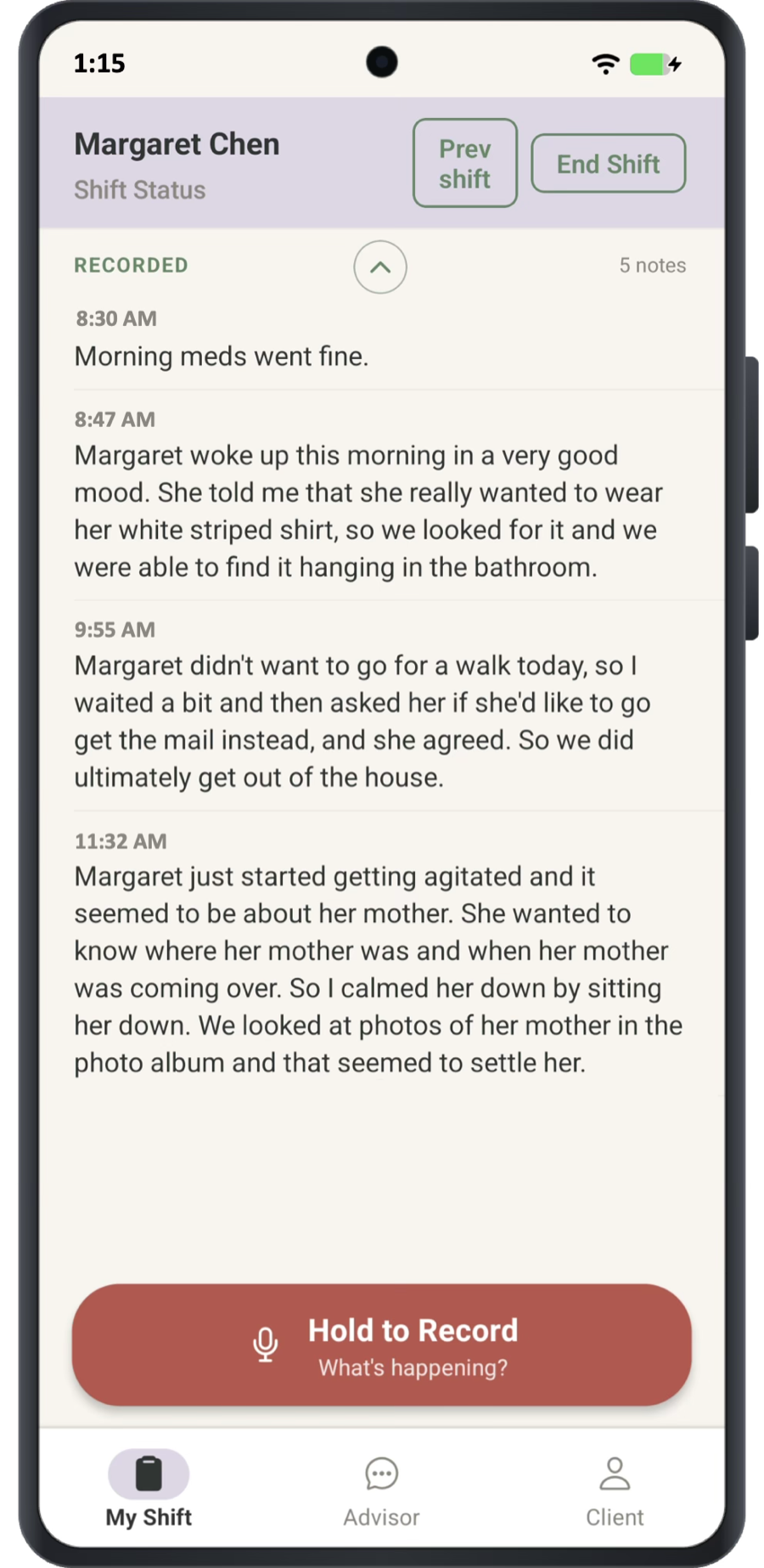
She speaks a few seconds about what she sees.

Hold the button, say what happened, let go. Five or ten seconds, in English or Spanish. No forms, no typing, no password to remember. If the internet is spotty in the client's home, it keeps working and syncs afterward.

She isn't filing paperwork. She's telling the next person what they need to know.

The CareDepth shift screen on an Android phone, showing a shift in progress with voice notes already recorded.

When she isn't sure what to do, she asks.

A client refuses her medication and won't say why. A man resists help to the bathroom because being independent matters more to him than being safe. A woman with dementia accuses the aide of stealing. Most aides are undertrained for these moments, and they're in them alone — the supervisor may be on another line, or in another client's home.

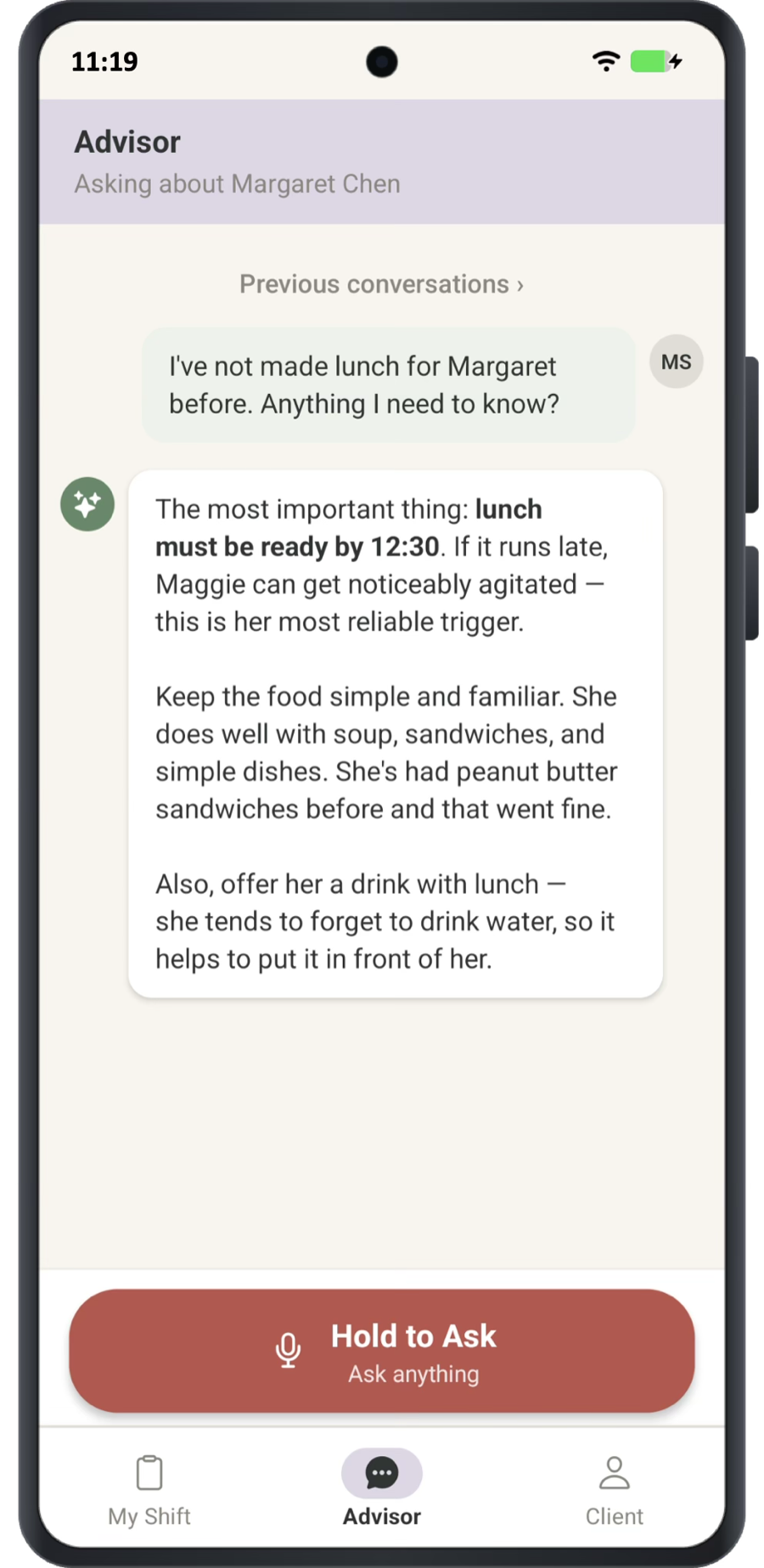
The advisor answers with what's known about this specific client — not general advice about dementia. Her routines, her preferences, what agitates her, what settles her.

The CareDepth advisor screen on an Android phone, answering an aide's question about lunch for a specific client.

At the end of the shift, the summary is already written.

She doesn't write it. It comes from what she said during the shift.

The next aide reads it before she walks in. The supervisor sees what actually happened in the home. It doesn't depend on two people overlapping in a doorway, and it doesn't stay behind in the house.

Margaret Chen

Shift with Maria Santos on Friday, August 14, from 7:45 AM to 3:45 PM.

  • ✓ Morning medication reminder
  • ✓ Breakfast
  • ✓ Morning walk (15 min, uses walker)
  • ✓ Engage with photo album or music
  • ✓ Lunch by 12:30 (important — gets agitated if delayed)
  • ✓ Afternoon hydration check

Margaret woke up in a very good mood this morning. She had a specific request to wear her white striped shirt. They spent some time looking for it and found it hanging in the bathroom.

She took her pills without any difficulty, though she really does not like the vitamin D ones.

Margaret didn't want to go for a walk today. Maria offered to go get the mail instead and she agreed to that.

Late morning Margaret got agitated and kept asking about her mother. Maria sat her down and they looked through some photos together, which seemed to calm her down. Maria had asked the advisor about this — the advisor said not to try to explain where her mother is, as that's likely to increase her distress, and suggested redirecting with the photo album on the coffee table.

Lunch went well. They had a nice conversation about favorite meals.

Margaret got a little quiet and tired in the afternoon and dozed off for about ten minutes.

Maria also asked the advisor ahead of making lunch whether there was anything she needed to know. The advisor flagged that lunch needs to be ready by 12:30, that late lunch is Margaret's most reliable trigger for agitation, and that she tends to forget to drink water so it helps to put a drink in front of her.
Alongside the software you already have

CareDepth is not a second EMR; it isn't trying to replace WellSky, AxisCare, or HHAeXchange, or perform scheduling, EVV, billing, compliance — keep all of it exactly where it is.

Here's a question worth asking: what share of your aides actually use the software you pay for? And do they use it because it helps them, or because they have to?

Most documentation tools ask the aide to do work that benefits someone else. She fills in a form so the office has a record. There's nothing in it for her, so a meaningful number of aides don't bother, and the ones who do give you the minimum.

CareDepth is built the other way around. She opens it because it helps her — she's stuck, and it tells her something useful about this client right now. And she records because she knows who's coming next. Aides don't want to leave the next person guessing. That instinct already exists in your agency; CareDepth gives it somewhere to go.

The record you get is a byproduct of both. Not a tax the aide pays for someone else's benefit.

CareDepth turns what your aide knows about the client into what your agency knows about the client.

What that gives you:

  • A real handoff at every shift change, not just when two aides happen to overlap
  • Aides who have support in the moment, instead of guessing alone
  • Continuity when an aide is out sick, on vacation, or gone for good
  • Concrete examples of good aide judgment you can actually recognize people for
  • A meaningful answer for the family who wants to know how their mother is really doing

Who's building this

I'm Jay Barnes. I spent nineteen years at Fidelity Investments, eleven of them building the web software people use to trade and manage their money, and nine years as the primary caregiver for my parents through dementia — first my father, then my mother.

CareDepth comes from the intersection of those two things. I know what the tough moments in a client's home actually look like, because I spent years in them, and I know how to build software people will actually use.

CareDepth has no sales team. That means you talk to the person who built it, and when you tell me something is wrong, it changes.

Member, Home Care Alliance of Massachusetts

Where things stand

CareDepth is working software, not a concept. The screens above are the real app.

I'm talking with a small number of independent Greater Boston agencies before general availability.

If you run an agency and if 'shift to shift continuity' or 'turnover losing your client knowledge' sound like a problem you have, I'd like to talk. Fifteen minutes, and I'll bring the app and show you a shift.